THE TECtonic SHIFT: Part 2
The conversation that needs to be shared however it can be shared.

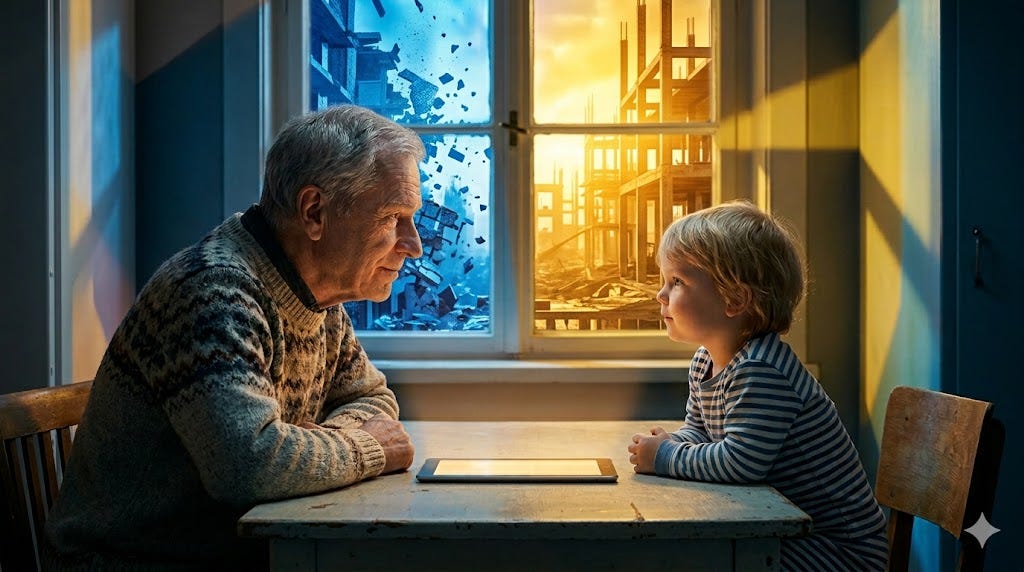
A few days ago I published a piece called The TECtonic Shift. It was a conversation about the thing nobody is saying to you: that the world you prepared for is ending, that the map your parents gave you has expired, and that the people building the most powerful technology in human history cannot tell you what it looks like in five years.
I did not plan a follow-up. The piece said what I needed it to say.
But then I watched what happened when people read it.
Which made me reflect on what I understood just occurred.
The warning landed. That part traveled without much friction. The dissolving career ladder, the expired maps, the institutions that have not moved. People absorbed that more readily. Shared it. Quoted it. Intimated that they felt it in their own families.
But the second half of the piece, the part that said the same technology dissolving the old world is simultaneously building something extraordinary, traveled differently. It moved slower. Quieter. For some (maybe most) readers it did not seem to land at all.
I noticed it. And rather than assume too much about what occurred, I got curious.
So I went looking.
It turns out there is a body of research that describes exactly this pattern. Not as a flaw in the reader… as a feature of the species.
The human brain processes NEGATIVE information with more weight, more speed, and more permanence than POSITIVE information.
A psychologist named Rick Hanson describes the BRAIN as Velcro for the bad and Teflon for the good.
Two hundred thousand years of evolution wired us this way. The rustle in the grass that might be a predator gets more processing power than the fruit tree that might be dinner. That kept us alive on the savanna.
It may not be serving us well in the Bardo, the space between what was and what will be, the concept from Tibetan Buddhism I explored in Part 1.
The Stanford HAI AI Index Report 2025 found sharp regional divides in how people see AI. In China, 83% of people see AI products as more beneficial than harmful. In Indonesia, 80%. In Thailand, 77%. In the United States, 39%.
That is not a difference in information.
It is a difference in posture.
Reinhold Niebuhr, the theologian and political philosopher, wrote about what he called “sophisticated pessimism”: the tendency, during periods of intense change, to adopt despair as A MARKER OF INTELLIGENCE.
To assume both:
That seeing danger is the educated position.
That seeing possibility is evidence you have been sold something.
Niebuhr saw another trap too.
He called it “naive optimism”: the belief that things will work out because they should. Because progress is inevitable. Because the technology will save us if we just get out of its way.
Neither one of those positions has ever built or survived anything… anything built or survived with these foundations was in spite of them.
The sophisticated pessimist describes the fire and believes that describing it is a form of engagement.
The naive optimist denies the fire and calls the smoke a sunset.
And while both of them argue about the proper response, the house is being redesigned by whoever is still in the room.
There is a third posture.
It does not have a famous name.
Niebuhr never described it.
The behavioral scientists have not labeled it.
But you know it when you see it.
It is the person who sees what the pessimist sees, holds every warning, carries the full weight of what is breaking, and progresses anyway.
… PROGRESSES ANYWAY
Not because they are ignoring the danger.
Because they refuse to let awareness of the danger become the reason to stop.
Ask yourself: when you read the part about 40% of global jobs being reshaped by AI by 2030, how did it sit in you?
Did it confirm something you already feared?
And knowing what you NOW know about sophisticated pessimism, did it land a little too comfortably?
And when you read that three million researchers are using a single breakthrough to design therapies for diseases that have stolen people from their families for generations, and that the first drugs entirely designed by AI are entering clinical trials this year, how did that sit?
If the first one landed heavier, you are not broken.
You are human.
But you might be generating an incomplete picture.
And incomplete pictures tend to produce ineffective responses.
No matter which direction you choose… or whether you choose one at all.
Here is what is happening right now.
Not projected.
Happening...
Nations are at war over energy.
ALWAYS…
Oil surged past $116 a barrel after the president addressed the nation last night with no exit strategy and no plan for the Strait of Hormuz. Gas is above $4 a gallon at your pump. American service members are deployed in a conflict that exists for one reason: the world still runs on a fuel that is finite, concentrated in unstable regions, and weaponized by the men who control it. Your grocery bill went up because of it. Your savings shrank because of it. People are dying because of it.
Today…
Right now…
While you read this…
YET….
The age of energy scarcity is ending.
And it is difficult to overstate what that means.
Because energy is not one issue among many.
It is the issue underneath every other issue.
It is the foundation that every other breakthrough sits on top of.
And it is the reason your world feels like it is coming apart.
Abundant energy does not just end scarcity.
Hear the following…
ENERGY ABUNDANCE ends the systems built on scarcity!..
The borders that exist to control resources lose their justification.
The nationalism that feeds on competition for what is finite loses its fuel.
The centralized power structures that depend on being the ones who decide who gets how much of what lose their leverage.
Scarcity is not just an economic condition.
It is the framework of the globe.
It is a tool of control.
And the people holding that tool?..
Can SEE... EXACTLY what happens when it disappears.
An era of energy abundance is an era of abundance in EVERYTHING.
Food.
Water.
Medicine.
Education.
Opportunity.
As energy becomes abundant and nearly free…
Everything that depends on it becomes solvable. Not through charity. Not through policy. Through physics.
And the wars…
The never ending wars end.
No nation invades another over a resource that is everywhere.
No dictator leverages a pipeline against a free people.
No child puts on a uniform to secure a shipping lane for a commodity that the sun provides for free.
The conflict you are watching on your screen tonight exists because we are still killing each other over the last century’s energy. This next century’s energy makes that fight obsolete.
HEALTHCARE. The breakthroughs I described in Part 1, the protein mapping, the diagnostic tools, the atmospheric models, those are the surface. Beneath all of them sits energy. When energy is nearly free, computing is nearly free. When computing is nearly free, the AI systems designing your treatment, diagnosing your disease, and monitoring your recovery become available to every clinic in every village on earth. The first drugs entirely designed by AI are entering human clinical trials this year. Not someday. Now. For diseases that have stolen people from their families for generations. The medicine your grandparents could not access because of where they were born becomes the medicine your grandchildren receive because of the century they were born into.
EDUCATION. When the cost of intelligence collapses to zero, the gatekeeper who told you your zip code determined your future loses the gate. The child in rural Mississippi and the child in Manhattan and the child in rural India receive the same quality of instruction, the same access to knowledge, the same chance to become whoever they have the capacity to become.
This is the very beginning, not the summary.
Let your imagination roam.
The possibilities are grounded and awe inspiring.
But I need to be honest with you about something else…
The path from here to there is not clean.
RIGHT NOW… the very technology computing these breakthroughs is consuming enormous amounts of energy and water.
DATA CENTERS are being built in communities that were not consulted, drawing from power grids that are already strained, draining aquifers that serve the people who live there.
In some states, COAL PLANTS slated for retirement are being kept alive to power AI infrastructure.
In others, ELECTRICITY PRICES in DATA CENTER CORRIDORS have surged while residents absorb the cost.
The tools that may end scarcity are, in this moment, contributing to it.
That is not a contradiction to dismiss.
It is a cost that real people are paying right now so that a future they were never asked about can be built on top of them.
People like Bernie Sanders and organizations like More Perfect Union are raising this and they are not wrong to do so. Demanding that communities have a voice in what gets built where, and who bears the cost of building it, is not fear. It is citizenship. It is exactly the kind of participation this piece is calling for.
And abundance, even when it arrives, does not automatically mean equity.
Oil is abundant.
It did not end poverty.
It concentrated wealth.
If abundant energy follows the same path, if it is captured by the same handful of entities that control the current system, then the age of scarcity does not end. It just changes uniforms.
The vision I have laid out is real.
The science is real.
The breakthroughs are physical, testable, and happening. But the DISTRIBUTION of what they produce is not a physics problem.
It is a human one.
And human problems require human beings in the room demanding that the benefits reach everyone, not just the people who built the infrastructure.
And further human cost is already here.
Entry-level hiring in AI-exposed occupations dropped fourteen percent.
Not because companies are firing people.
Because they have quietly stopped hiring for roles the technology is absorbing.
The ladder is not being pulled up.
The bottom rungs are dissolving.
The age of energy scarcity is ending.
AND…
Entry-level hiring dropped fourteen percent.
Both of those are true.
At the same time.
About the same technology.
The question is not which one you believe.
Both deserve belief.
The question is whether you can hold them both without collapsing into one or the other.
Because the collapse, in either direction, costs you the only thing that matters right now.
Agency.
The power to decide what you do with what is coming instead of having it decided for you.
Daron Acemoglu, the MIT economist who won the Nobel Prize in 2024, said something that belongs on EVERY KITCHEN TABLE where this conversation is not happening.
He was talking about the future AI is building.
It is a design choice.
That sentence is the entire fight…
“ .. a design choice.”
The person who collapses into DESPAIR treats AI as weather.
Something that HAPPENS to you.
The person who collapses into BLIND FAITH treats it as salvation.
Something that RESCUES you.
Both positions surrender your seat at the table.
The 2025 Human Development Report said it directly: DETERMINISTIC views, BOTH the despairing kind and the triumphant kind, ARE DISEMPOWERING because..
They obscure the fact that the future is being shaped by the choices made today.
AI is coming.
That is no longer a question.
It is not a proposal before a committee.
It is not waiting for permission.
It is here and it is accelerating and nothing any government does will stop it.
The only question left is this: will it be used to preserve the systems that are already failing you, or will it be harnessed to build the ones that replace them?
… or will it be harnessed to build the ones that replace them?
RIGHT NOW…
The people in power are using AI to surveil, to automate, to consolidate, and to control.
They are loud about its dangers because a frightened population asks for protection.
And protection keeps the protectors in charge.
They are silent about its possibilities because a population that understands what abundant energy, abundant intelligence, and abundant medicine actually mean does not ask for protection.
It asks for the door.
AI is the most powerful tool ever created.
The question is not whether it will reshape the world.
It will.
The question is whether it reshapes the world for the people living in it or for the people running it.
That is the fight.
The only fight.
Everything else is a distraction.
The only thing standing between this future and the one we are living in right now is the willingness of the people running our nations to redirect their resources toward it. And the insistence of the people living in those nations that the benefits reach everyone.
The technology is ready.
The leadership is not.
It is not incompetence.
It is self-preservation.
The people running the world built their power on a map that abundant energy makes obsolete.
And they know it.
We are spending trillions to fight over the last century’s energy while this century’s energy sits waiting for someone with the courage to fund it, scale it, and set it free. And the communities absorbing the cost of building it deserve a seat at the table before the concrete is poured, not after.
That is not a technology problem.
That is a decision problem.
And decisions are made by the people in the room.
Are you in the room?
The relationship between scarcity and control is not a sidebar.
It is the architecture.
Issue 100 of The Edict will develop it fully.
I want to be honest with you about where I stand.
I have been through stretches of my life that should have ended differently. Stretches where my own map was fading. Where the ground was not shifting, but threatening. And I came through. Not because I had a solid plan. Because I kept moving. Because I refused to let the worst thing that happened to me become the truest thing about me.
What I carry is something closer to defiance.
A refusal to concede the ending before the story is written.
And everything I have lived tells me that the people who keep moving, who refuse to sit down in the wreckage and call it home, are the ones who build what comes next.
That is not a philosophy.
It is a scar that healed into a compass. That is MY faith.
I did not anticipate the responses to The TECtonic Shift.
They came at unexpected angles that offered both questions and genuine fortifications of my own perspectives of what I had written.
A reader who is building an AI company of her own, focused on consciousness and human connection, read the piece and shared it with her entire community. It seems she did not separate the warning from the possibility. She held them together and built her response around both. She said the piece put into words something she had been carrying for a long time.
Another reader, someone whose depth in these comment sections I have come to respect, identified the thread in the piece that most people passed over: not the job displacement, which he correctly noted is widely discussed, but the wisdom frame. The Bardo. The Dreamtime. The insistence that ten thousand years of human knowing is not a comfort but an instruction set. He saw it. And then he seemingly opened that door for himself and possibly others.
These are people who held the whole piece.
Not the half that confirmed what they already feared.
The whole thing.
And they moved forward… progressed.
I do not share this to congratulate the work. I share it because it tells me something about the conversation itself. Whatever the piece achieved did not come from sounding an alarm. It came from holding both the dissolution and the emergence in the same hand and refusing to drop either one.
That is the posture this moment is asking for.
That is a defiance that this time calls for like no other.
Geoffrey Hinton, the man who helped build deep learning and won the Nobel Prize for it, resigned from Google to warn the world about what he sees coming.
Yoshua Bengio has called for international treaties.
Stuart Russell compared humanity’s position to a species whose survival depends on the goodwill of something more intelligent than itself.
These are not alarmists.
They are the architects.
And they are asking us to pay attention.
At the same time, Demis Hassabis, who built AlphaFold and shared the Nobel Prize for it, projects that the first pharmaceutical drugs entirely designed by AI will enter human clinical trials this year.
Not in a decade.
This year.
Therapies for Alzheimer’s. Treatments calibrated to individual genetic architecture. A future in which the cost of intelligence drops so low that the gates that kept the best medicine, the best counsel, and the best education behind walls of privilege finally fall.
Hinton is afraid.
Hassabis is building.
Both are telling the truth.
Both deserve to be heard.
And neither one is telling you what to do with what you are hearing.
That part is yours.
I called this publication The Edict because I believe that everything is connected. And something in me suggested I might have a way of offering a lens on that connection that was worthy of putting out into the world.
Simply, that is my effort.
Not dumbed down.
Not filtered through ideology.
Not served with a conclusion already attached.
I am not here to tell you what to feel or think.
I am here to put the evidence on the table, as clearly as I can, and trust you to do what people have always done when they are given the truth and the space to sit with it.
They figure it out.
Together.
The way they always have.
The dissolution is REAL.
The emergence is REAL.
The wiring that makes you feel the first one more than the second one is real.
And the agency you carry to shape what comes next is the most real thing of all.
The sophisticated pessimist will tell you it is already too late.
The naive among us will tell you it will work itself out.
The defiant ones, the ones who have been through something and came out still moving, will tell you something different.
It is not too late.
But know.. it will not simply work itself out.
And nobody is coming to make this decision for you…
The Bardo is still here.
The old map is still blank.
And ten thousand years of human wisdom is still saying the same thing:
You were built for this.
Not because you are special.
Because you are human.
And humans do not wait for the story to be written for them.
They pick up the pen.
*This was not planned as a sequel. The TECtonic Shift was written as a complete piece. But the reactions, the conversations, and the research that followed convinced me that the conversation is not finished. It may just be starting.*
*Produced under the COGNITOR methodology for transparent human-AI collaboration. I directed every question. Claude (Anthropic) provided research support, structural feedback, and draft development. The editorial architecture, personal testimony, and decision to publish are mine. The human stays in the room.*
*Mark Dtayo / Founder, RISE USA / Editor/Cognitor, The Edict*
This conversation began in THE TECtonic SHIFT

If this work has meant something to you, your support keeps it going. Thank you for being in the room.
Research sources: Stanford HAI AI Index Report 2025, World Economic Forum Future of Jobs Report 2025, 2025 Human Development Report, the published work and public statements of Nobel laureates Demis Hassabis, Geoffrey Hinton, and Daron Acemoglu, the behavioral research of Rick Hanson, the philosophical framework of Reinhold Niebuhr, and the Anthropic Economic Index (March 2026).
Jon, A big thank you. The fact that you found this through Alexa and carried it further is all I could hope for. The Bardo does not get navigated alone. It gets navigated by people who find/unite with others to move forward. As you are doing right now. Again, grateful.
Yes! We must hold both in the human container of love. I discovered your post via Alexa Divett and have been sharing it widely with many since reading Part 1 earlier today and now part 2.
We must embrace The Bardo with our defiant human dance! Thank you for your writing and HumanNess