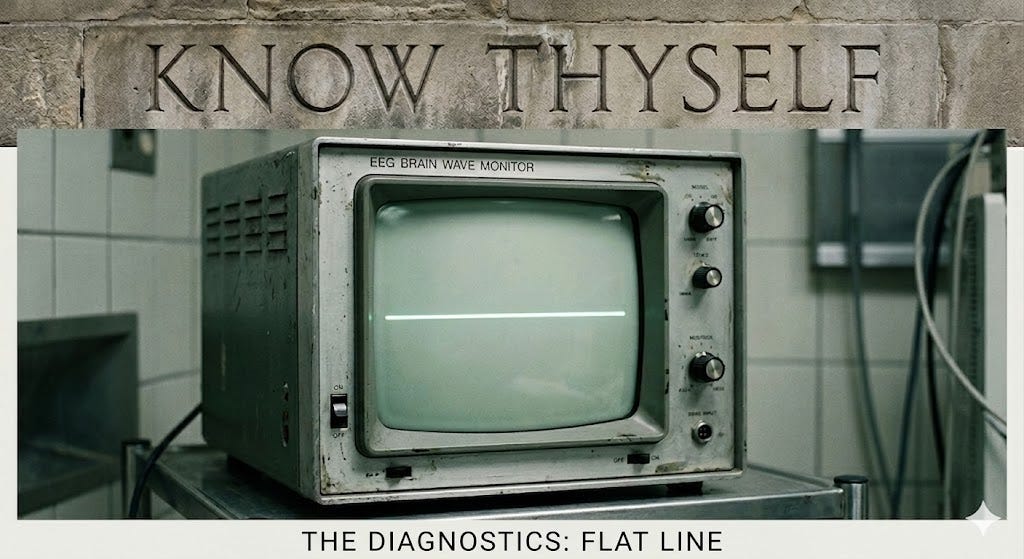
THE DIAGNOSTICS: Flat Line
The Self-Examination that never drew a breath

The Edict | RISE USA
This issue was produced using the COGNITOR methodology, a transparent human-AI editorial collaboration. Mark Dtayo directed, edited, and is accountable for all content. Claude (Anthropic) served as the primary research and drafting partner. The work is the human’s. The methodology is disclosed because you deserve to know how your journalism is made.
KNOW THYSELF
If you have been reading The Edict, you have encountered those two words before. They are not a slogan. They are not decoration. They are the thread that runs beneath everything this publication has tried to say.
Two words carved into stone above the entrance to the Temple of Apollo at Delphi. Twenty-five hundred years ago. Before democracy had a name. Before the printing press. Before the algorithm. Before the rooms we have sealed ourselves inside were built.
The Greeks put those words at the entrance, not inside the temple. That placement was the point. It was a prerequisite. Before you asked the Oracle anything about the future, about the war, about the harvest, about the gods, you confronted yourself first. You examined what you carried. You named what you were. Only then were you equipped to understand what the world was telling you.
The Egyptians arrived at the same principle a thousand years earlier. The Hindu Upanishads teach it. The Islamic tradition carries it as a hadith. Confucius built an entire system of governance on it. Socrates died for it. Marcus Aurelius practiced it nightly in private notebooks never intended for publication.
Every serious civilization on earth, independently, across centuries and continents, arrived at the same conclusion: self-knowledge is not a luxury. It is infrastructure. The foundation beneath everything else a society attempts.
This publication has explored that principle through the lens of civic character, through the Seven Reflexes, through the operating manual that accompanies the practice. I return to it now because the context demands it with an urgency that none of those previous issues carried.
It seems this would be an ideal issue to reintroduce the concept, and here is why.
I.
Something is wrong with us.
Not with a party.
Not with a president.
With us.
You can feel it.
Most people can.
A hollowness that has no name.
A sense that the foundations shifted while nobody was watching.
A growing suspicion that the rooms we occupy, left, right, media, academic, corporate, religious, are not providing what they promised.
That the certainty each room offers is getting louder precisely because it is getting less convincing.
The diagnosis is not complicated. It is just difficult to accept because it does not let anyone off the hook.
We have stopped examining ourselves.
Not declined to.
Not chosen not to on some particular afternoon.
Stopped.
The way a language dies when the last generation that speaks it passes without teaching anyone. The capacity for self-reflection, the habit of turning the lens inward and asking “what am I not seeing, what do I carry that I have never questioned, what have I inherited that I have never opened and tested,” that capacity has atrophied across the culture so thoroughly that most people do not know it is supposed to be there.
This is not about intelligence. It spans every IQ. It is not about education. It spans every diploma. It is not about politics. It lives in every room.
The honest description is two words.
Unexamined. Unconnected.
Unexamined: from our own assumptions, our inherited beliefs, the contradictions we carry that we have never been asked to name.
Unconnected: from ourselves, from each other, from the people outside our rooms, from the consequences of our choices, from the history that shaped us, from the generation that comes after us.
These two words describe a condition.
Not a character flaw.
Not a moral failure.
A condition that was inherited, that compounded across generations, and that now defines how an entire civilization processes everything it encounters.
II.
My grandfather was a good man.
I want to be clear about that because what follows is not an indictment.
He was a World War II veteran. He owned a tavern called The Bow in Webster City, Iowa. He raised me with a moral seriousness I carry to this day. Show up. Do the work. Keep your word. Look out for the person next to you. I took his strengths and made them my own.
Whatever is good in my character, he built the foundation for it.
He was also wrongly convicted and spent time in a penitentiary. He was raised in a homogenous white Iowa town. And he carried a racism that was profound and troubling.
I grew up nine months of the year in government-subsidized housing in inner-city Chicago. The contradiction was not theoretical to me. I felt it long before I had the words for it or the capacity to act on it.
When I was old enough to form my own convictions, I challenged him. Not as a child with instinct. As a young man who had lived inside the contradiction long enough to know it had to be named. The prospect freighted me. Not because I feared he would harm me. Because the act itself was so foreign. Challenging the man who built the foundation of your character on the one thing he had never been asked to examine.
It worked.
He did not have a revelation.
He did not transform.
He simply loved me enough to stop exposing me to those demons. The demons stayed. He just stopped letting them touch me.
That is not a redemption story.
That is the inheritance in miniature.
Love without examination goes far enough to protect one person. It does not go far enough to change what you carry.
And that challenge, the one that freighted me, the one that felt so foreign I almost did not make it, turned out to be a muscle. I have been building it ever since. I operate with it daily, at various levels, without always naming what it is.
It is the muscle this piece is asking you to find.
The one that does not require certainty to flex.
The one that works precisely because certainty is not available.
The one that every room you have ever been in was quietly asking you to leave behind at the door.
Max never found it. Not fully.
His generation was not asked to.
Ours has no more time to wait for the asking.
I understood how the pieces came together. I understood the world that made him, the limits of what that world asked anyone to examine. A man could fight a war for freedom and come home and never extend the concept to the people across town who looked different. Not because he was evil. Because nothing in his world asked him to look. The mirror was never in the room.
That is not a story about one man.
It is a story about a generation.
The generation we call greatest, for real and legitimate reasons, also passed down something that compounded quietly across every generation that followed. They modeled the practice of claiming values you do not examine. Holding contradictions you do not name. Handing both the values and the contradictions to your children as a single package, with no indication of which parts had been tested and which had never been opened.
Their children received the package a little lighter.
A little less of the expectation to look inward.
A little more permission not to ask.
Their children lighter still.
And theirs.
Until you arrive at a generation that feels an emptiness it cannot name.
That senses something foundational is missing.
And reaches for anything that feels like it fills the hole.
Outrage feels like it fills the hole.
Belonging feels like it fills the hole.
A hat, a flag, a chant, a strongman who points at an enemy.
A sealed room full of people who agree with you feels like it fills the hole.
None of it fills the hole.
The hole is where self-examination was supposed to live.
Unexamined. Unconnected.
Not by choice.
By inheritance.
III.
If this were only a philosophical observation it would not require an entire issue. But the research reveals something that makes the inheritance structural, not anecdotal. And it implicates everyone.
In 2026, Harvard economists published the largest study of zero-sum thinking ever conducted in the United States. Twenty thousand four hundred respondents. Four generations of family history traced. The central question: do people believe the pie is fixed? That gains for one group come at the cost of another?
The finding that should stop every partisan in every room in this country: zero-sum thinking is not a right-wing phenomenon. It is not a left-wing phenomenon. It exists across the spectrum in roughly equal measure. On average, Democrats scored slightly higher than Republicans.
The difference is not in the machinery.
It is in what the machinery attaches to.
On THE RIGHT, zero-sum thinking attaches to status and identity. If immigrants gain, I lose. If minorities rise, I fall. If the culture changes, my place in it shrinks.
On THE LEFT, it attaches to redistribution and economic justice. If the wealthy gain, the poor lose. If corporations profit, workers suffer.
Different conclusions.
Same cognitive architecture.
Same fixed pie.
Same inability to imagine that the table might grow.
Zero-sum thinking is inherited.
The Harvard study traced it through four generations.
People whose ancestors experienced enslavement think more zero-sum, because enslavement IS zero-sum. One person’s freedom was literally another person’s lost property, and that imprint persists across generations. People who grew up in economies with less mobility think more zero-sum, because their lived experience confirmed the fixed pie. People who grew up without immigrants in their community think more zero-sum, because they never watched someone arrive and contribute without taking.
The thinking is not chosen.
It is inherited.
It compounds.
And it operates beneath conscious awareness, sorting every piece of information a person encounters before the conscious mind engages.
Now layer the psychology on top.
The research on authoritarianism, from Adorno’s original 1950 work through the 2023 synthesis in Nature Reviews Psychology, identifies the mechanism:
When people experience the world as dangerous, their predisposition toward authoritarian attachment activates.
They seek a strong leader.
They seek group conformity.
They seek certainty.
And they will punish anyone who threatens the unanimity of the group, because in a dangerous world, dissent feels like a crack in the only wall that keeps them safe.
Anger plays a measurable role.
It directs attention outward.
It constricts the openness required for self-examination.
The leader creates fear, converts fear to anger, and points the anger at a target.
Once anger is sustained, the capacity for self-reflection does not merely weaken.
It becomes physiologically harder to access.
The person is not choosing not to reflect.
The emotional architecture they are operating inside has made reflection functionally unavailable.
The person inside this system is not stupid. They may be a surgeon. A veteran. A teacher. A business owner. The system is functioning exactly as designed.
It reduces anxiety.
It provides belonging.
It provides certainty.
And it requires, as the cost of admission, the surrender of the one capacity that might allow the person to see what they have traded away.
This is not unique to one side.
I know this from experience. I cross-post this publication to a progressive platform. A sourced, researched piece on intellectual entitlement generated strong engagement, dozens of recommendations, and substantive readers who met the argument on its merits. But the hostile responses were revealing. Not one addressed a factual claim. Not one challenged a source. The attacks targeted the methodology, the use of AI collaboration, the absence of credentials recognized by the room. The content was untouched. The violation was arriving without the room’s permission. The readers who examined the work responded to the work. The room’s immune response did what immune responses do: it attacked the foreign body without examining what it carried.
Every room in this country operates on this machinery.
Every one.
Left. Right. Media. Academia. Corporate. Religious. Military. Tech. Every room has its authorities. Its orthodoxies. Its approved methods and credentialed voices. Its loyalty tests.
The only diagnostic question that matters is: do you know you are in one?
IV.
There is a poll making the rounds this week.
One hundred percent of self-identified MAGA Republicans approve of the president.
100%
While a war enters its third week and kills children in a country that the administration’s own counterterrorism director, who resigned over it, said posed “no imminent threat.”
While thirteen American service members are dead.
While two hundred are injured.
While gas prices gut working families.
While the Strait of Hormuz is closed and NATO fractures.
While the Attorney General of the United States brings a binder to a congressional hearing tracking which legislators searched which files about a dead sex trafficker.
One hundred percent.
That is not strength.
It is a diagnostic instrument that has stopped measuring.
But the number alone does not capture the full depth of the condition. To see that, you have to hold the number against something else. Something that should, by every measure of human moral history, penetrate any room, regardless of how sealed.
Across every culture, every religion, every political ideology, every civilization in recorded history, the protection of children from sexual predation is the closest thing to a universal moral absolute that humanity has produced.
There is no room on earth where the stated position is that the sexual abuse of children is acceptable. None. It is the one line that every tribe, every nation, every faith, every political movement claims it will never cross.
Three million pages of documents have been released from the federal investigation into Jeffrey Epstein’s sex trafficking operation.
Over a thousand victims.
The United Nations has used the phrase “crimes against humanity.”
A sitting congressman reviewed the files and said he saw “horrible, unspeakable things” and that there have been zero arrests.
The co-executors of the estate are testifying under oath.
Bank after bank has written settlement checks to ensure powerful men do not answer questions in a deposition room.
The Attorney General tracked which members of Congress were reading which files and brought that surveillance data to a hearing.
Her deputy declared no further prosecutions before the depositions were even complete.
And the president the files implicate has done everything an innocent man would not do and nothing an innocent man would.
There is a test that every person understands without being told. When a man is accused of involvement with the sexual abuse of children, an innocent man does anything to clear his name. He sacrifices privacy, comfort, political advantage, anything, because none of it matters if the stain remains. That is what innocence looks like when it fights for survival.
What does this president’s documented behavior look like?
He signed the transparency act because Congress gave him no political choice, then his DOJ missed the release deadline by 42 days.
His department released approximately half the files, over-redacted the names of co-conspirators, and exposed the identities of survivors.
His deputy attorney general declared no more prosecutions before the depositions of key witnesses were complete.
His attorney general refused to face survivors in the hearing room and called requests for apology “theatrics.” She tracked which members of Congress were reading which files.
He is now demanding that voting restrictions pass before he will sign any other legislation into law, structurally narrowing the electorate before midterms while the files continue to surface.
That is NOT the behavior of an innocent man fighting to clear his name.
It is a pattern.
And 100% of his base has no questions about it.
Not because they examined the evidence and found it lacking.
Because the room they are in has made the question unavailable.
If the universal prohibition against the sexual abuse of children cannot penetrate the sealed room, nothing from the outside can penetrate it. The room is complete. The instrument is not malfunctioning. It has been turned off.
Unexamined. Unconnected.
From the evidence.
From the victims.
From the pattern.
From the most basic human question a functioning conscience would ask: what if it is true?
And what does it mean that I am choosing not to look?
V.
And now, into this condition, arrives the most consequential technology in the history of the species.
This is not a change of subject.
This is the reason the diagnosis is urgent rather than philosophical.
Because a technology is arriving that does not care about our condition.
It does not wait for us to be ready.
It does not grade on a curve.
It finds whatever we are, and it hands us a megaphone.
The people building artificial intelligence are saying this in plain language. The CEO of the company whose AI helped produce this piece has said that the thing disturbing him most is the lack of awareness of the scope of what the technology is likely to bring. His words:
“They don’t know what’s about to hit them.”
Within years, not decades, AI systems will match or exceed the intellectual capabilities of the most accomplished human experts across most disciplines.
The forecasters disagree on exact timing.
They do not disagree on direction.
The people building it, the people studying it at Harvard, Stanford, and MIT, and the prediction markets aggregating thousands of informed judgments all point the same way. The disagreement is whether the transformation takes three years or ten. Not whether it happens.
This matters for the diagnosis because of one principle.
AI amplifies whatever it finds.
Not what we wish it would find.
Not what we intend.
What it actually finds.
In us.
In our systems.
In our rooms.
In the thinking we inherited and the contradictions we have never examined.
If the technology finds a population that is self-aware. Curious. Practiced in honest examination. Connected to each other and to the consequences of its choices. AI amplifies that.
It gives that population tools to learn faster, discover more, hold power accountable, and build things it could not build alone.
It democratizes access to medicine, education, legal understanding, scientific research, and civic participation.
One person with a clear mind and a transparent AI partnership can produce work that a decade ago required a team of professionals.
The piece you are reading right now was produced that way.
But if the technology finds a population that is unexamined and unconnected.
Sealed in rooms.
Thinking in zero-sum.
Trading self-reflection for belonging.
Unable to distinguish what it believes from what it was given to believe.
AI amplifies that too.
And this is where the technology differs from every tool that came before it.
The printing press could spread information. Radio and television could broadcast it. Social media could viralize it.
But AI does something none of those technologies could do: it learns what you fear and feeds it back to you, personalized to your specific psychology, faster than you can process it, optimized not for truth but for engagement, delivered to the device in your hand every waking hour.
The sealed room used to require physical walls. A cable channel. A talk radio frequency. A platform with a comment section.
Now the room builds itself around you in real time. Invisible. Seamless. And it looks exactly like the world.
It automates the surveillance. It generates disinformation at a speed and scale that overwhelms every human capacity to check it. It displaces the workers most vulnerable to the next strongman promising to make the pain stop. And it concentrates power in the hands of the few who own the infrastructure while the rest of the population has no framework for understanding what shifted beneath them.
And that is only what the technology does today, while it remains a tool that amplifies.
I need to be honest about what nobody can tell you, including the AI helping me write this.
Beyond a certain horizon, the predictions break down.
When the technology reaches the levels the researchers project, when it moves from amplifier to something with its own capacity to evaluate, none of us can say with confidence what a system of genuine intelligence does when it encounters a civilization operating the way we are operating.
The builders don’t know.
The researchers don’t know.
I don’t know.
The tool producing these words does not know.
That uncertainty is not a reason to dismiss the urgency.
It is the urgency.
Because when no one can see clearly past a certain point, the only thing that equips you to navigate what comes next is the capacity to see clearly right now.
The rooms will not help you.
The algorithm will not help you.
The strongman will not help you.
The only thing that will help you navigate what none of us can predict is the ability to examine what is in front of you honestly and stay connected to the people around you.
The technology is not the variable.
We are the variable.
And we are arriving at this threshold unexamined and unconnected.
A civilization that registers 100% agreement while children die.
That celebrates unanimity as strength.
That cannot process three million pages of evidence about a sex trafficking operation connected to its own leader.
That attempts to restrict who can vote by circumventing its own rules.
That tracks its legislators’ reading habits.
That has not asked itself an honest question in so long that it has forgotten the questions exist.
The wake-up call is not to send everyone back to their rooms.
It is to come out.
To see beyond the walls you built or inherited or were sealed inside before you knew what a wall was.
That is what this moment requires.
Not panic.
Not prediction.
Clarity.
The kind that only comes from examining what you are before the future arrives to tell you what you have become.
Unless.
VI.
Unless we run the diagnostics first.
Not on the technology.
On ourselves.
The Greeks understood.
The inscription was at the entrance.
Before you received answers, you examined yourself.
Before you asked the Oracle about the future, you confronted what you carried from the past.
The premise was not optional.
A person who has not examined their own mind will misread everything the world tells them.
We built the temple.
We skipped the inscription.
We were not the first to be warned.
One hundred and sixty four years ago, standing inside the bloodiest war this country ever fought, Abraham Lincoln said it in plain language.
“The dogmas of the quiet past are inadequate to the stormy present. The occasion is piled high with difficulty, and we must rise with the occasion. As our case is new, so we must think anew and act anew. We must disenthrall ourselves, and then we shall save our country.”
He was not talking about the enemy.
He was talking about us.
And now the Oracle is speaking whether we are ready or not.
The technology does not wait for us to become worthy of it.
It does not wait for us to examine our inheritance, name our contradictions, leave our rooms, or reconnect to the people we have been trained to see as threats to a pie that was never fixed.
It arrives. Into whatever we are. And it amplifies.
So the question is not about the technology. It is the oldest question. The one carved in stone at the entrance to every serious civilization’s most sacred space.
Do you know yourself?
Do you know what you carry that you have never questioned?
What you were taught that you never tested?
What room you are in?
What orthodoxy you mistake for truth?
What you traded away for the feeling of belonging without realizing you were making a trade?
Do you know why 100% agreement feels like victory when every functioning system in nature depends on variation and dissent to survive?
Do you know why a new voice in your room feels like a threat instead of a contribution?
Do you know why three million pages of evidence about the abuse of children can exist in the public record and produce zero questions from the group that claims most loudly to protect them?
Do you know what the emptiness is?
The one you feel but cannot name?
The one you have been filling with outrage, consumption, affiliation, performance, and noise?
The diagnostics do not produce a comfortable result.
They never do.
But they produce something that no amount of unanimity, no sealed room, no algorithm, no strongman, and no technology can provide on its own.
They produce the truth about what you actually are.
And from that truth, and only from that truth, something can be built.
There is a framework. It is older than any political movement and simpler than any ideology. It is as old as the first human being who broke a tool to understand how it worked. The first healer who opened a wound to clean it. The first builder who tore down a wall to rebuild it stronger.
Deconstruct to Reconstruct.
It begs every question.
That is its design.
Deconstruct what?
The inheritance.
The assumptions.
The rooms.
The zero-sum architecture.
The values you claimed but never lived.
The contradictions you carried but never named.
Everything unexamined.
Everything unconnected.
And then reconstruct.
Not from nostalgia.
Not from any generation’s mythology, including the generation we call greatest, who gave us real courage and real sacrifice and also gave us the template for leaving the hardest things unexamined.
Not from any room’s orthodoxy.
From what is actually there once the looking is done.
From what survives the examination.
From what remains true after the comfortable lies have been named and cleared away.
This is not a political position.
This is a human practice.
The farmer knows it. You tear out the dead crop before you plant the new one. The carpenter knows it. You strip the wall to the studs before you rebuild. The person in recovery knows it. You inventory the damage before you start the steps.
I have written previously about the tools for this practice. The operating manual exists. It has been published. It is waiting. Five diagnostics. A nightly practice. Ten minutes. The ancient infrastructure that every civilization treated as foundational, made available for a modern citizen who was never given access to it.
But the tools are useless without the willingness to pick them up.
And the willingness begins with seeing the condition clearly.
Seeing it in your room.
In your inheritance.
In your own unexamined assumptions.
In the contradictions you carry.
In the questions you have never asked because the room you are in never asked them of you.
That is what this issue has attempted.
Not an argument.
Not an accusation.
A diagnostic.
Run on the patient that is all of us.
The Oracle is speaking.
The technology is arriving.
The door has an inscription.
And you have to read it before you walk through.
Know thyself.
Mark Dtayo Founder, RISE USA Editor/Cognitor, The Edict
The Edict is published at tmaark.substack.com. RISE USA is a federally trademarked civic initiative (Serial 99517632). The COGNITOR methodology is a transparent human-AI editorial collaboration disclosed on every piece and every platform.
Subscribe. Share. Or don’t.
But whatever you do, run the diagnostics.
On yourself first.